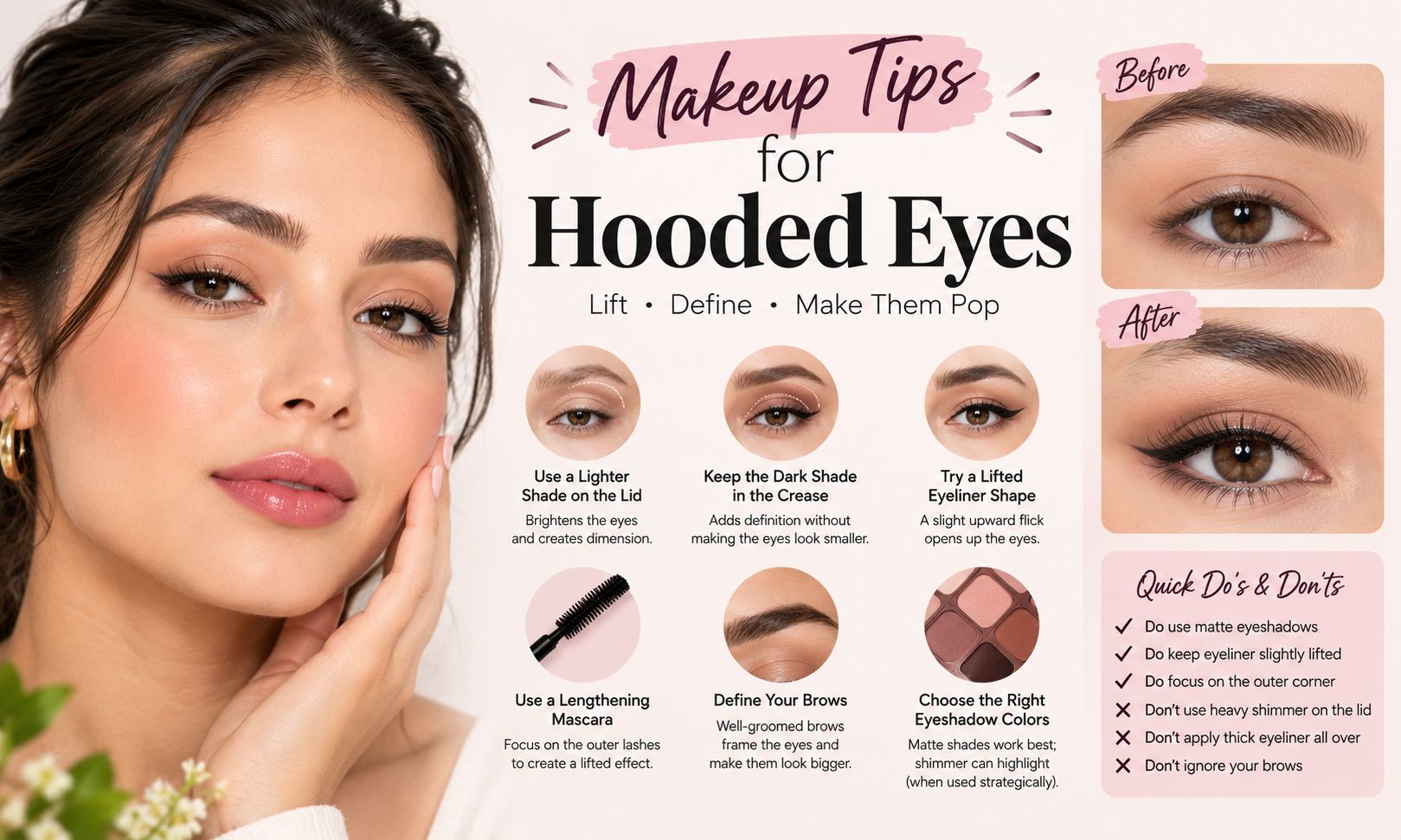
Quick answer: The best makeup tips for hooded eyes are to place eyeshadow slightly above the natural crease so it stays visible, use matte shades to define and a little shimmer in the centre of the lid, and apply eyeliner with your eyes open. Curl your lashes and use a lengthening mascara to open the eye.
Key takeaways
- Always check your look with your eyes open and looking straight ahead.
- Put definition above the crease so it does not disappear when your eyes are open.
- Keep shimmer to the centre of the lid and matte shades in the outer corner.
- Draw liner with your eyes open, in short strokes.
- Primer and clean tools stop shadow transferring onto the fold.
If you have ever done a beautiful eyeshadow look and then opened your eyes to find it has vanished, you know the frustration of hooded eyes. Hooded eyes are common, and they are not a problem to fix. They simply need a slightly different map. Once you know where to put colour, how to draw liner and which products to avoid, you can do almost any look you like. This guide walks you through it step by step.
What are hooded eyes?
Hooded eyes have a fold of skin that falls from the brow bone down over the crease, so part or all of the movable lid is hidden when the eyes are open. It can be natural from a young age or become more noticeable with age as skin loses firmness.
How can you tell if you have hooded eyes?
Look straight into a mirror with your eyes open and relaxed. If you cannot see your crease, or the lid space is small, you probably have hooded eyes. If you can see a good amount of lid with a visible crease, your eyes are not hooded.
Hooded eyes, monolids and droopy lids: what is the difference?
- Hooded eyes: a fold of skin covers some or all of the crease.
- Monolids: there is no visible crease at all. Many of the same tricks help, but placement can differ.
- Droopy eyelids: excess upper eyelid skin is called dermatochalasis, while a lid that sits low because of a muscle problem is called ptosis. Both can look like hooded eyes. The American Academy of Ophthalmology’s EyeWiki describes the first in its entry on dermatochalasis. If your lids droop suddenly, one side is lower than the other or your vision is affected, see a doctor.
This guide is about makeup and not about medical conditions.
How should you prepare your eyes before makeup?
Preparation does more for hooded eyes than any shadow shade.
- Moisturise lightly. A small amount of eye cream keeps the skin from looking dry. Let it sink in.
- Use an eye primer. A thin layer of primer helps shadow stay put. This matters because the lid touches the brow bone fold all day and can cause creasing and transfer.
- Conceal lightly. A thin layer of concealer evens out colour. Choose a creamy formula, as heavy, dry products crease easily. Our guide to the best drugstore concealer for dry skin offers some options.
- Set with a little powder. Dab a tiny amount on the lid to keep the base from moving.
If you notice blue or purple shadows under or around your eyes, you can neutralise them first, as we explain in our article on how to use color corrector makeup.
How do you apply eyeshadow on hooded eyes?
Place the colour above the crease
The most useful rule is to look in the mirror with your eyes open and place shadow slightly above your natural crease, on the brow bone area that you can still see. This keeps the colour from hiding behind the fold.
Use matte and shimmer in the right places
- Matte shades work best for the outer corner and the area above the crease. They create depth and shape.
- Shimmer or satin shades work best in the centre of the lid, where they catch the light and make the eye look more open.
- Avoid heavy shimmer on the fold. It can emphasise texture and transfer easily.
Try a three-shade look
This simple structure works for almost everyone.
- Transition shade. A soft, skin-toned colour one or two shades deeper than your skin, blended above the crease with a fluffy brush. This is your base.
- Definition shade. A deeper matte shade placed in the outer corner and slightly above the crease, in a small triangle shape.
- Highlight shade. A light shimmer pressed on the centre of the lid and in the inner corner.
Blend until there are no hard edges, and check your look with your eyes open after each step.
Which colours work best?
There are no rules, and personal preference matters most. Warm browns, taupes and soft bronzes are easy to blend and look natural. Deeper plums, navy or forest green can be dramatic and work well if you keep them above the crease. Pale, creamy shades on the lid reflect light and open the eye.
How do you apply eyeliner on hooded eyes?
Draw with your eyes open
Eyeliner is often the point where hooded eyes cause trouble. If you draw a smooth line with your eyes closed, the fold hides or distorts it when you open them. Look straight ahead, then use a pencil or gel liner to draw small, connected dashes along the lash line. Join them up gently.
Choose a wing that suits your shape
- Lifted wing: draw it upwards from the outer corner along the line of your lower lash, rather than straight outwards.
- Short, smudged wing: a soft, smoky flick defines without needing a precise line.
- Thin line: a skinny line close to the lashes can look neat when a thicker line would disappear.
Tightlining and waterline
Lining the inner rim of the upper lash line, called tightlining, makes lashes look fuller without showing a line when your eyes are open. Lining the lower waterline can make eyes look smaller, so many people skip it or use a nude pencil instead. If you wear contact lenses or have sensitive eyes, take extra care, and always use clean products.
How should you do mascara and lashes?
Lashes are the secret weapon for hooded eyes.
- Curl first. Hold the curler at the base for a few seconds, then move it up. Curled lashes lift the lid and open the eye.
- Choose lengthening mascara. Lashes that extend beyond the fold stay visible.
- Concentrate on the outer lashes. Wiggle the wand at the outer corner and pull it up and outwards.
- Avoid clumpy, heavy formulas. They can smudge onto the lid fold. If your mascara is waterproof, learn how to take it off safely with our guide to how to remove waterproof mascara.
What about brows?
Brows frame the eyes and affect how much of the lid you see. Brush your brows upwards and fill any gaps with light, hair-like strokes. A gentle arch can create the look of a bit more lid space. Avoid placing a very low, heavy brow right on top of the fold.
How do you create an easy everyday hooded eye look?
Here is a five-step version that takes about five minutes.
- Prime and conceal the lid, then set with a touch of powder.
- Blend a neutral transition shade above the crease with a fluffy brush, looking in the mirror with eyes open.
- Add a deeper brown to the outer corner and slightly above the crease.
- Press a satin shade on the centre of the lid.
- Curl, then apply mascara, focusing on the outer lashes. Add a thin line of liner if you like.
You can use this as the eye step in our 5 minutes natural makeup tutorial or in your daily makeup routine.
How do you adapt these tips for mature hooded eyes?
As skin changes with age, the lid can become softer and crepey, and the fold can cover more of the eye. A few adjustments help.
- Choose creamy or satin textures over glittery or dry powders, which can settle into fine lines.
- Keep layers thin. Heavy product emphasises texture, so press colour on gently with a flat brush.
- Use a skin-toned base and avoid very pale lid colours that can look flat.
- Lift the outer corner with a soft brown rather than a black pencil, which can look harsh.
- Choose a gentle eye cream at night, and use a clean brush so you do not drag the skin.
- Do not chase symmetry. Many people have one lid that is lower than the other, and a small difference in shadow placement can balance it.
If you are building the rest of your face, our guide to the best foundation for mature skin covers bases that pair well with softer eye looks.
What mistakes should you avoid?
- Placing shadow in the crease only. It disappears under the fold.
- Using lots of shimmer on the fold. It highlights texture.
- Drawing liner with eyes closed. The line will not match when you open them.
- Applying too much product. Dense colour can look heavy on lids with little space.
- Skipping primer. Transfer onto the brow bone is common without it.
- Using dirty brushes. Old shadow muddies colour and can irritate the eyes. Check our guide to cleaning makeup brushes.
- Forgetting the rest of your base. If your skin needs a gentle, light foundation, our guide to the best foundation for mature skin can help.
Which tools help most?
- A fluffy blending brush for the transition shade
- A small flat brush to press shimmer onto the lid
- A small, angled brush or pencil for the outer corner
- A fine eyeliner pencil that sets quickly, or a gel liner with a thin brush
- An eyelash curler
- Cotton buds and a little remover to tidy edges
Frequently asked questions
How do you apply eyeshadow on hooded eyes?
Place the colour slightly above your natural crease so it stays visible when your eyes are open. Use matte shades for depth in the outer corner and a light shimmer in the centre of the lid. Blend carefully and check the look with your eyes open.
What eyeliner is best for hooded eyes?
A pencil or gel liner that sets quickly and does not smudge works well. Draw with your eyes open, using small strokes. A thin line or a soft, smudged wing is usually easier than a sharp, thick one.
Do hooded eyes look better with shimmer or matte shadow?
Both have a place. Matte shades give depth in the outer corner and above the crease, while a little shimmer on the centre of the lid makes the eye look more open. Avoid heavy shimmer on the fold.
How do I stop eyeshadow transferring on hooded eyes?
Use an eye primer, set the lid with a little powder, keep layers thin and avoid oily creams under your eyeshadow. Choose long-wear formulas if transfer is persistent.
Can you have hooded eyes at any age?
Yes. Some people are born with hooded eyes, and others notice them as skin changes with age. Hooded eyes are common, and many techniques work at any stage of life.
The bottom line
Hooded eyes are not a flaw. They just need a slightly different approach. Check your makeup with your eyes open, place colour above the crease, draw liner with a gentle hand and curl your lashes. A little practice goes a long way. For more ideas, explore our Makeup category.