Quick answer: Fashion week is a run of runway shows, usually lasting about a week, where designers present their next season’s collections to buyers, editors and guests. The four biggest take place in New York, London, Milan and Paris, twice a year, with smaller fashion weeks held in cities around the world.
Key takeaways
- Fashion week happens twice a year: Spring/Summer collections are shown in September and October, and Autumn/Winter collections in February and March.
- The big four run in a fixed order: New York, London, Milan, then Paris.
- Most catwalk shows are invite-only, but many cities now run public events, pop-ups and talks.
- You can follow every show for free through official livestreams and designer social channels.
- What you see on the runway reaches shops roughly six months later, and often filters into everyday style much sooner.
Say “fashion week” to most people and they picture a celebrity in the front row, a photographer’s flash and a model in a coat you’ll never own. That’s part of it. But fashion week is really a trade event, a marketplace dressed up as a party, and once you know how it’s put together, following it gets a lot more interesting.
This guide covers what a fashion week is, which cities matter, when the shows happen, how invitations work, and how to follow it all without ever setting foot in Paris.
What is fashion week, exactly?
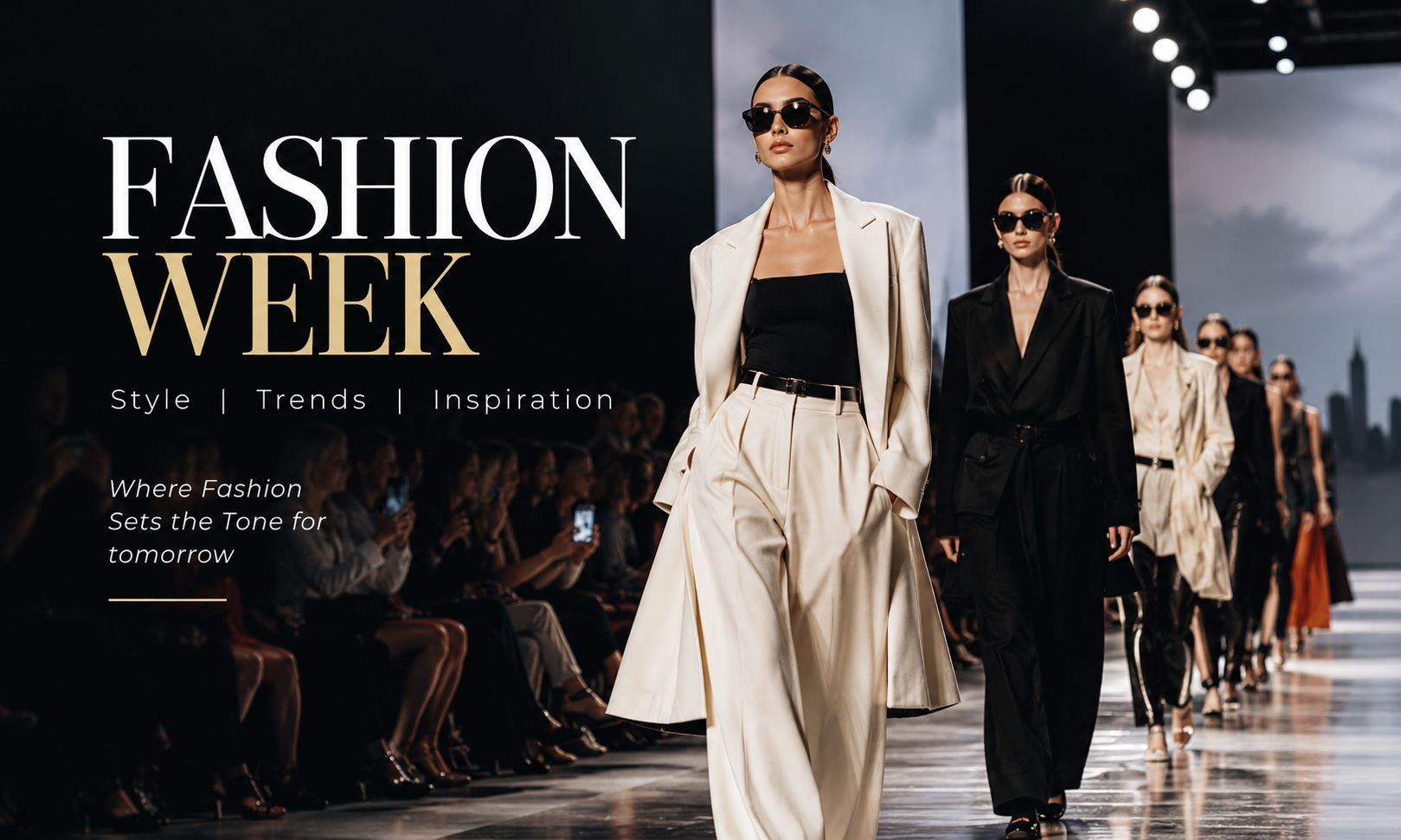
A fashion week is a scheduled block of days, often six to nine, when brands show their upcoming collections in quick succession. Designers present on a runway, in a showroom or at a staged event, and the audience is made up of retail buyers, magazine editors, stylists, journalists and influencers. Buyers decide what to stock in their shops. Editors decide what to feature. Everyone else watches the pictures arrive online.
The word “season” matters here. Fashion works months ahead of the weather. In February you’ll see coats and knitwear for next autumn. In September you’ll see linen and sandals for next spring. That gap confuses newcomers, but it’s simply how the industry orders, makes and ships clothes.
How a typical day works
A single day can hold ten or more shows, each lasting around fifteen minutes. Guests move between venues, which might be a grand hall, a car park, a gallery or a pavement closed off for the afternoon. Between shows come presentations, where models stand in a styled set so people can look at clothes up close, and showroom appointments where buyers place orders.
The shows themselves are only the visible tip. Behind them are weeks of fittings, casting, music edits and hair and make-up planning. A show that looks effortless on a screen has often been rehearsed to the minute.
Not every fashion week is the same
Some weeks are organised by genre. Ready-to-wear is the main event. Haute couture, the custom-fitted, hand-finished end of fashion, is shown in Paris, usually in January and July. Menswear has its own weeks, and bridal has its own calendar. Resort and cruise collections are often shown outside the main schedule.
The big four fashion weeks
Four cities carry the most weight, and the schedule is built around them. Each has a different personality, and each is run by a different body.
New York Fashion Week
New York goes first. It’s closely tied to the history of fashion week itself: the first organised event was called Press Week and was held in New York in 1943, when wartime travel made European shows hard to reach. It was created to show American designers to the American press. The Council of Fashion Designers of America supports the New York calendar today.
New York tends to favour commercial, wearable clothing, from sportswear to polished tailoring. It’s also where you’ll see plenty of brand spectacle, because many American labels sell directly to a mass audience.
London Fashion Week
London follows New York. The British Fashion Council organises it, and the city is known for backing young designers and graduates from its art schools. London tends to be the place where an odd idea shows up first and the rest of the industry catches on a few seasons later. London’s first official event took place in 1984.
London is also ahead on public access. For the September 2026 edition, reports on the event schedule pointed to pop-ups, exhibitions and talks open to visitors alongside the invitation-only catwalks, with dates listed as 17 to 21 September.
Milan Fashion Week
Milan is about craft, leather, tailoring and quiet confidence. Milan Fashion Week was officially established in 1958, and it’s home to some of the most established Italian houses. Expect rich fabrics, careful cutting and a certain polish. If you want to understand why a well-made coat costs what it does, Milan is where that argument is made.
Paris Fashion Week
Paris closes the cycle, and it carries the most theatre. The first event officially called Paris Fashion Week was held in 1973, though fashion presentations in the city go back much further. Paris is the home of haute couture and of the largest luxury groups, so the shows here tend to be the grandest, with huge sets, long guest lists and a fair amount of drama.
Because Paris comes last, it also acts as a summary. By the time the final show ends, the season’s main ideas have usually become clear.
When is fashion week? Dates and schedule
The calendar follows two main seasons.
Autumn/Winter: shown in February and March. The order is New York, London, Milan, Paris, with each city following the last in roughly three-week sequence.
Spring/Summer: shown in September and October, in the same city order.
Exact dates move every year, and cities sometimes tweak them to avoid clashes. Always check the official calendar rather than trusting an older article. The British Fashion Council, the CFDA, Camera Nazionale della Moda Italiana and the Fédération de la Haute Couture et de la Mode each publish the dates for their own city. If you’ve found a page that still shows 2024 dates, close it. It’s out of date.
Smaller fashion weeks worth watching
The big four get the headlines, but plenty of other cities run strong events, and some are better at showing what’s new.
- Copenhagen Fashion Week has built a reputation for sustainability rules that brands must meet to take part, and for relaxed Scandinavian style.
- Berlin Fashion Week leans towards experimental, street-led and independent labels.
- Tokyo Fashion Week is a good place to see unusual silhouettes and a strong youth scene.
- Lagos Fashion Week has become a showcase for West African design and textiles.
- Lakmé Fashion Week in India is a major event for Indian designers, with a strong focus on craft and textiles.
- Dubai and Arab Fashion Week bring in Middle Eastern couture and evening wear.
- Pakistan, Jakarta, Melbourne, Stockholm and many others run their own calendars too.
Some are consumer-friendly and sell tickets to the public. Others are trade-only. Check each organiser’s site.
How to attend fashion week
There are three realistic routes in, and only one of them involves an invitation.
Route one: industry access
Invitations go to buyers, editors, stylists, celebrities, and key clients, and each brand’s press team manages them. Getting one usually means working in fashion media, retail, styling or PR, or being a registered content creator with a real audience. If that’s your goal, start with internships at magazines, showrooms or PR agencies. They’re how most people get a foot in the door.
Route two: public events
This is where most readers will actually have a chance. Many fashion weeks now run events anyone can attend. London’s schedule includes free exhibitions, pop-ups and talks across the city, and in a recent line-up reported by Hello magazine, public events included designer showcases, gallery installations and shopping centre spaces with no ticket required. Check the official schedule for opening times, since some events need booking and a few have limited places.
Other cities do something similar, with consumer tickets, designer sample sales and open studio days. Search the organiser’s site a month ahead, because tickets can go fast.
Route three: volunteering and student programmes
Fashion colleges, local fashion councils and event producers often need extra hands for backstage work, front of house or social media. It’s unglamorous work, with long days, but it puts you inside the building and teaches you how a show is really built.
What to wear if you go
Wear something comfortable that you can walk in. Venues are spread across a city, shows run late, and you’ll stand in queues. Layers are sensible because halls can be cold and outside can be wet. Street style photographers tend to notice personal style, not the loudest outfit. A single strong piece, such as a sharp coat or an unusual bag, beats a head-to-toe costume.
How to follow fashion week from home
You don’t need an invitation to watch. Almost every show is shared online within hours, and many are livestreamed.
- Official livestreams. The big four councils and many designers stream shows on their own sites and social channels.
- Designer accounts. Brands post clips, backstage footage and full looks as the show ends.
- Magazine coverage. Editors write reviews, trend roundups and best-dressed lists, which help you sort the signal from the noise. We publish regular style, beauty and trend features, and you can find them all on Glowing Magazine.
- Street style galleries. These show how the people attending actually wear the trends, which is often more useful than the runway.
- Beauty coverage. Hair, make-up and nails at the shows tend to spread fast. A runway nail or hair colour can be on every feed within weeks.
How to read fashion week trends without getting overwhelmed
Hundreds of looks appear in a season. Here’s a simple way to find the ideas that matter.
Look for repeats. One designer showing a long skirt is a style choice. Ten designers showing it is a trend. Count how often a shape, colour or fabric appears across cities.
Separate the show from the wardrobe. Runways exaggerate. A giant coat on a catwalk usually becomes a more practical coat in shops. Look at the idea underneath: the colour, the proportions, the fabric.
Watch the accessories. Bags, shoes and jewellery often change first, because they’re the easiest way for a shopper to join a trend cheaply.
Check beauty too. Make-up artists and hairstylists set the mood for each show, and their choices often spread through salons quickly.
Wait for the shops. Pieces from a runway usually arrive in stores in the following season, so a spring show in September is the clothing you’ll see on the high street the next year.
Why fashion week matters
Fashion week is a business event before it’s anything else. It sets the order books for shops and brands, gives young designers a chance to be seen by buyers, and creates jobs for models, stylists, photographers, makeup artists, hairstylists, set builders and production crews. It also shapes the visual language of an entire season, which is why you’ll start to notice certain colours or shapes appearing everywhere once the shows have ended.
It’s also changing. More brands show outside the traditional calendar. More events are open to the public. And sustainability, size inclusion and diverse casting are now questions every show gets asked, even if the answers vary.
Frequently asked questions
What is fashion week?
Fashion week is a scheduled run of runway shows and presentations where designers show their upcoming collections to buyers, editors and guests. It usually lasts around a week and takes place twice a year. The best known are held in New York, London, Milan and Paris.
How many fashion weeks are there?
There are four main fashion weeks, in New York, London, Milan and Paris, each held twice a year. Many other cities, including Copenhagen, Berlin, Tokyo, Lagos and Lakmé in India, also run their own, so the total each year is well into the dozens.
When is fashion week?
Autumn/Winter collections are shown in February and March, and Spring/Summer collections in September and October. New York goes first, followed by London, Milan and Paris. Exact dates change yearly, so check the official council calendar for each city.
Can anyone attend fashion week?
Most catwalk shows are invite-only, but many cities run public events, exhibitions, talks and pop-ups that anyone can join. London is a good example, with free events across the city. Check the organiser’s site for tickets and opening times.
Why is fashion week important?
It’s where brands present their collections to the people who buy and promote them, so it sets the trends and orders for the coming season. It also gives emerging designers exposure and creates work for thousands of people across the industry.
Conclusion
Fashion week looks like a party, but it works like a market, and the clearest way to enjoy it is to treat it as a preview. Watch for repeated ideas across cities, ignore the extreme looks, and pick one or two details to try yourself. The runway is just the first draft of what you’ll wear next.