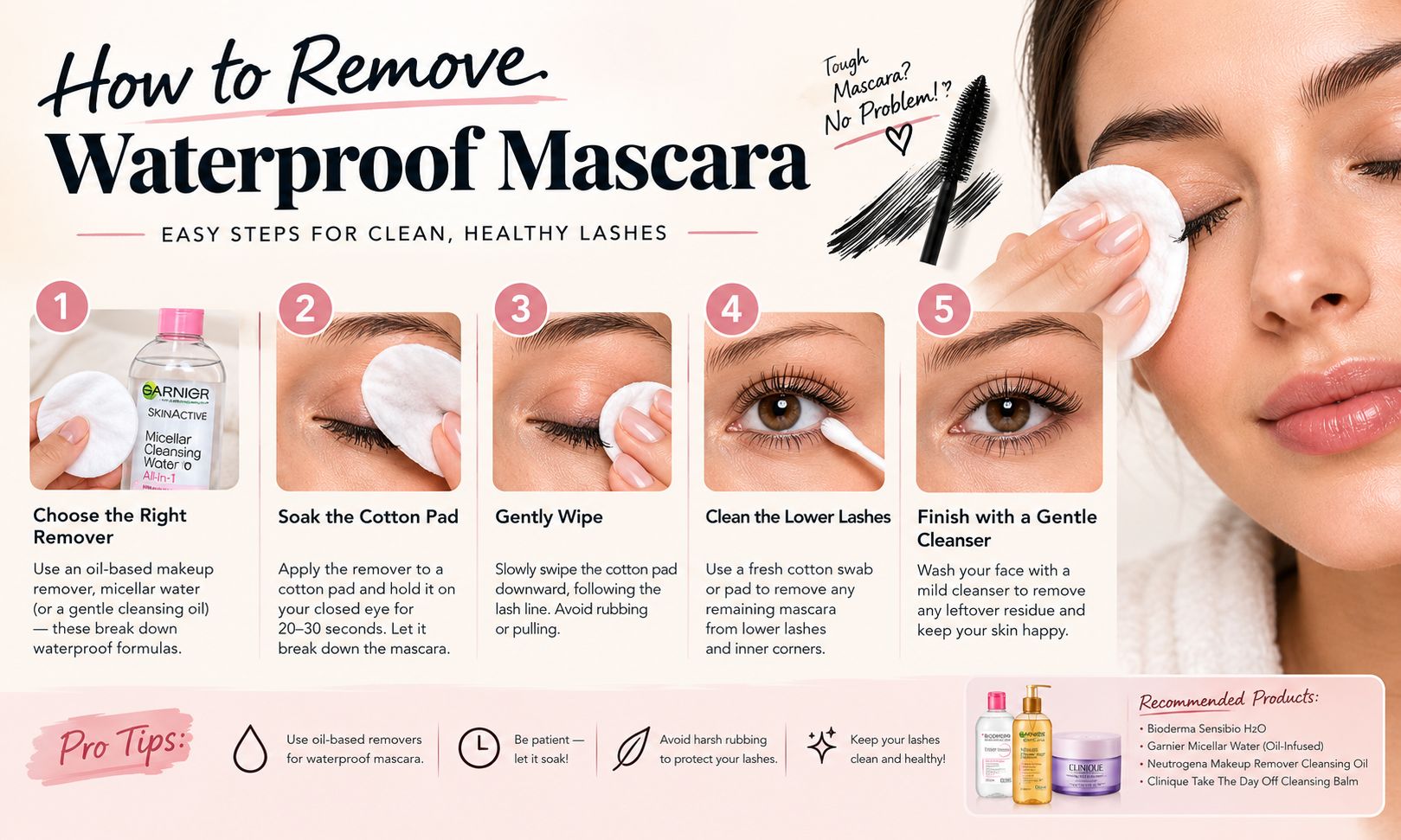
Quick answer: To remove waterproof mascara, soak a cotton pad in an oil-based or dual-phase eye makeup remover, hold it over your closed eye for 15 to 20 seconds, then wipe gently downwards in the direction of lash growth. Repeat the press-and-hold rather than rubbing harder.
Key takeaways
- Oil dissolves waterproof mascara. Rubbing only damages lashes.
- Patience is the method: press, wait, then wipe.
- Micellar water can work on lighter formulas, but waterproof ones often need a second step.
- If you wear lash extensions, check with your technician before using any oil.
- Redness, pain or discharge after wearing eye makeup needs medical advice.
Waterproof mascara does exactly what it promises. It survives rain, sweat, tears and a long day, which is the reason you bought it. The catch comes at bedtime, when the same stubborn formula refuses to budge and the temptation is to scrub until your eyes sting. That is the worst thing you can do. This guide explains why waterproof mascara clings so tightly, shows a gentle method that works, and helps you choose the right remover for your situation.
Why is waterproof mascara so hard to remove?
Regular mascara is largely water-based, so water and a cleanser can break it down. Waterproof formulas are built differently. They contain waxes and film-forming polymers that create a water-resistant coat around each lash, and that coat does not dissolve in water. To get it off, you need a product that can break down the wax and polymer, which is why oil-based and dual-phase removers are the usual advice.
Rubbing is tempting because it seems to work, but it pulls on the lash and the delicate skin around it. Over time repeated friction can loosen lashes and irritate the eyelids.
What do you need to remove waterproof mascara?
Gather these before you start:
- An oil-based or dual-phase eye makeup remover, a cleansing balm or a cleansing oil
- Soft cotton pads (not shredded cotton wool that leaves fibres behind)
- Cotton buds for the lash line
- A gentle facial cleanser
- A clean towel
Wash your hands first, and take out contact lenses before you begin.
What is the step-by-step method?
- Shake the remover if it is dual-phase. The oil and water layers need to mix.
- Soak a cotton pad. It should be wet but not dripping.
- Close your eye and press the pad over your lashes. Hold it there for 15 to 20 seconds. Maybelline’s guidance on removing eye makeup without losing lashes suggests exactly this press-and-hold approach.
- Wipe gently downwards. Move in the direction of lash growth, with very light pressure. If mascara remains, do not rub harder. Press again for another 10 seconds.
- Use a cotton bud for the lash line. Dip it in the remover and roll it along the base of the lashes to pick up smudges.
- Cleanse your face. A gentle cleanser removes any oily residue so it does not sit around your eyes overnight.
- Pat dry. Use a clean towel and press rather than rub.
The whole process takes about two minutes, which is often less time than the scrubbing it replaces.
What are the best types of waterproof mascara remover?
Oil-based and dual-phase removers
These are designed for waterproof formulas. The oil layer dissolves the wax and polymer, while the water layer helps rinse away residue. They tend to be the most reliable for waterproof mascara and long-wear liner. The only downside is a slightly oily feel, and some people notice blurry vision for a few minutes afterwards.
Cleansing balms and oils
A balm or oil melts waterproof mascara easily. Warm a small amount between your fingertips, press it over closed lashes for a few seconds, then wipe with a damp cloth or pad. If your balm is not marketed for eyes, keep it away from the inner eye and use a small amount.
Micellar water
Micellar water is a gentle option that works well on regular mascara and light makeup. Many formulas struggle with waterproof mascara, so expect to hold the pad longer or finish with a second product. Look for a waterproof-specific version if you favour this type.
Remover pads and wipes
Pre-soaked pads are convenient for travel and after the gym. Because it is easy to scrub with them, take care to press and wait. Avoid heavily fragranced wipes if your eyes are sensitive.
Which remover suits which situation?
| Situation | Good choice | Why |
| Everyday waterproof mascara | Dual-phase remover | Breaks down the waterproof coat quickly |
| Heavy or long-wear eye makeup | Cleansing balm or oil | Melts layers of product in one go |
| Very sensitive eyes | Fragrance-free remover made for sensitive eyes | Fewer ingredients that can sting |
| Travel or after the gym | Remover pads | Convenient, but press rather than scrub |
| Lash extensions | Oil-free cleanser, after asking your technician | Oils can weaken the adhesive |
What if you wear contact lenses?
Take your lenses out before you start. Oil-based removers can leave a film that clouds lenses and blurs your vision, and trapped makeup particles under a lens can be uncomfortable. If you remove your lenses after your makeup, you risk transferring product from your fingers to the lens, so wash your hands well and take the lenses out first. Choose a remover labelled as suitable for contact lens wearers if you are prone to stinging, and keep your lens case clean. If your eyes feel gritty, red or sore after removing makeup, leave your lenses out and speak to an optician or doctor.
How do you remove waterproof mascara without a remover?
Sometimes you are away from home or have run out. A few household options can work in an emergency.
- A plain plant oil, such as olive, almond or coconut oil, on a cotton pad. Oils can break down waterproof mascara, but they are not designed for eye use. Use a very small amount, keep it out of your eyes and avoid it if you wear contact lenses or have sensitive or dry eyes.
- Cold cream or a rich moisturiser. In a pinch, these can soften mascara so you can wipe it away gently.
- A cleansing balm from your routine. Press and hold, as above.
Things to avoid include hand soap, hot water, rubbing alcohol and scrubbing with a dry flannel. They can strip the skin, sting and encourage lash loss.
What if you wear lash extensions or have had a lash lift?
Be careful. Many oil-based products can weaken the adhesive that holds extensions in place, which is why lash technicians commonly recommend oil-free cleansers. Waterproof mascara is also usually not recommended with extensions because it needs oil to remove. If you have extensions or a recent lash lift, ask your technician which products are safe, and consider a lighter, water-washable mascara instead.
Which mistakes damage lashes?
- Rubbing back and forth. It pulls lashes and irritates the lid.
- Pulling at stuck clumps. Soak them again instead.
- Scraping with fingernails. This can scratch the skin and cause infection.
- Sleeping in mascara. Old product can irritate the eyes and may contribute to clumping and breakage.
- Removing dry. Dry lashes are more fragile, and dry mascara does not slip off.
- Using old, contaminated products. Mascara is a common route for bacteria because the wand goes in and out of a damp tube. Many eye-health organisations suggest replacing it roughly every three months, so check the symbol on the packaging.
- Using dirty tools. Brushes, sponges and applicators carry old product and oil. For tips on keeping them clean, see our guide to how to clean makeup brushes.
How should you care for your lashes and eyelids afterwards?
- Pat the area dry rather than rubbing.
- Give your lashes a break. Wear regular, washable mascara some days and skip it on others.
- Moisturise gently. A small amount of fragrance-free eye cream can calm dry, tight lids.
- Do not forget your lips. If you wear lots of long-wear makeup, your lips can get dry too. Our guide to the best lip oil for dry lips has ideas.
- Include removal in your routine. A tidy evening routine makes it easier to stay consistent. See our skincare routine for beginners for a simple template.
When should you see a doctor?
If you develop very red eyes, eye pain, discharge or swelling after using eye makeup, stop using the product and speak to a doctor. Cleveland Clinic’s dermatologists note that a very red eye, drainage or pain after applying makeup is a reason to call a doctor, as explained in their article on makeup and breakouts. Do not wait for it to clear by itself, and do not wear makeup on irritated eyes.
Troubleshooting: what if…
My eyes sting after removal? The remover may be too strong or may have got into your eyes. Rinse with lukewarm water. Try a fragrance-free remover formulated for sensitive eyes next time, and hold the pad longer rather than pressing hard.
My lashes feel oily? Cleanse your face afterwards with a gentle cleanser. A little residue is normal, but it should rinse away.
Stubborn flecks remain? Dip a cotton bud in remover and roll it along the lash base. Do not scrape.
I am losing a lot of lashes? Some natural shedding is normal. If you see bald patches or sudden loss, speak to a doctor, as medical conditions can be responsible.
Frequently asked questions
Can you remove waterproof mascara with just water?
Not effectively. Water alone cannot dissolve the wax and polymer that make the mascara waterproof. You need an oil-based or dual-phase remover, or a cleansing balm or oil, to loosen it.
Does micellar water remove waterproof mascara?
Sometimes. Standard micellar water often handles regular mascara but may struggle with waterproof formulas. A micellar water designed for waterproof makeup, held on the lashes for longer, can work, though you may need a second step.
Is it safe to use coconut oil near your eyes?
Plain oils can break down mascara, but they are not made for the eye area and may cause irritation or blurred vision. They are also not suitable for contact lens wearers or people with sensitive eyes. A remover designed for eyes is the safer choice.
How do I remove waterproof mascara with lash extensions?
Ask your lash technician first. Oil-based products can loosen the adhesive, so many technicians recommend oil-free cleansers and avoiding waterproof mascara altogether.
How often should I wear waterproof mascara?
There is no strict rule, but it is kinder to your lashes to save it for occasions when you need it, such as holidays, weddings or rainy days. Use a regular mascara the rest of the time.
The bottom line
Waterproof mascara is only difficult if you rush it. Choose an oil-based or dual-phase remover, press it over your closed eyes for 15 to 20 seconds, wipe gently downwards and cleanse your face. Treat your lashes kindly and they will reward you. For more ideas, explore our Makeup category and our guide to makeup tips for hooded eyes.