You bring a photo to your nail appointment, point at a slim, softly tapered set and say, “Like this.” Two hours later, you walk out with nails that are either too pointed, too stubby, or oddly boxy. It happens all the time, and the reason is usually simple: nobody agreed on what “almond” actually means.
The almond nail shape is one of the most flattering and most misunderstood cuts in manicuring. This guide explains what defines it, how it differs from lookalike shapes, who it suits, how to file it yourself, and how to keep it from snapping. By the end, you’ll know exactly what to ask for and what to expect.
What Is the Almond Nail Shape, Exactly?
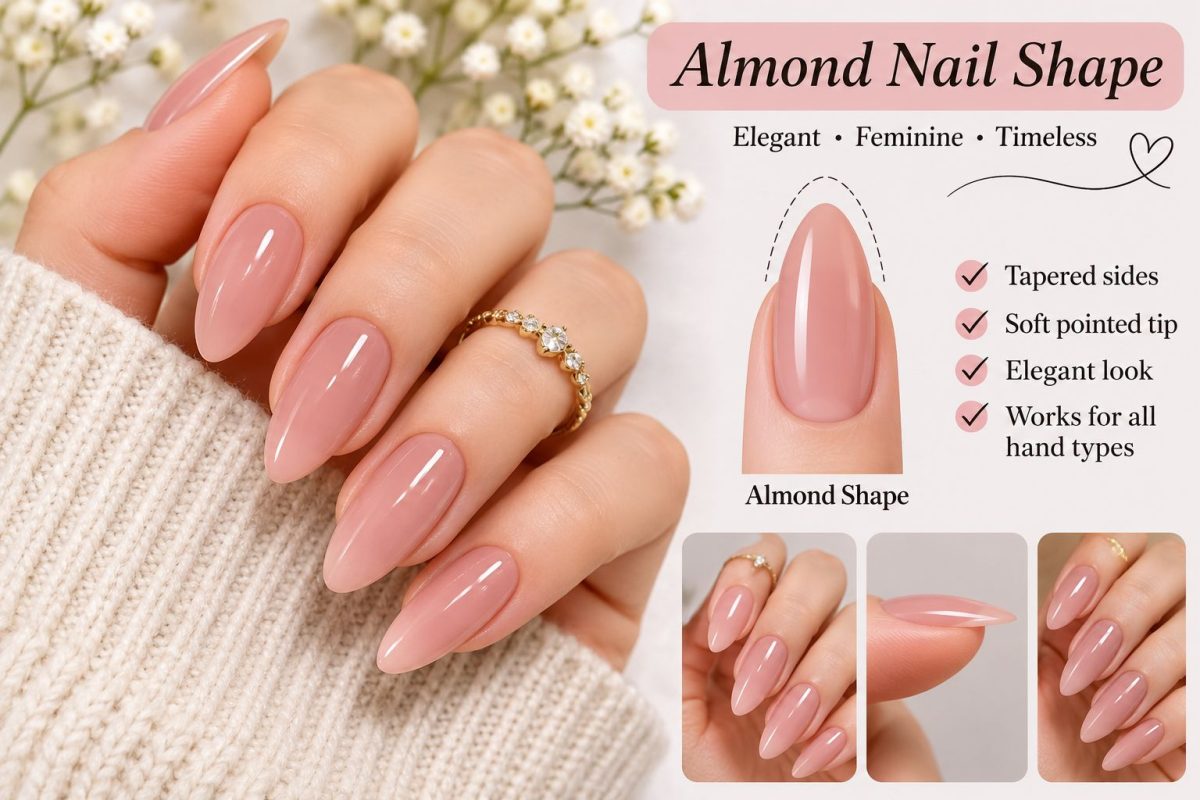
An almond nail is wide at the base, gently narrowed along the sides, and finished with a softly rounded tip. The outline mimics a real almond: a slim taper that ends in a gentle curve rather than a sharp point.
The side walls of the nail curve inward as they move toward the free edge, so the nail looks slimmer at the tip than at the cuticle. That taper is what separates almond nails from rounder, blunter shapes.
The Three Features That Define It
If you’re unsure whether a set is truly almond, check three things:
- Tapered sides: the nail narrows gradually from the base to the tip.
- A rounded peak: the very end is soft, not pointed.
- A smooth, even curve: there are no corners or flat edges anywhere along the outline.
Miss any of these and you’ve drifted into a different shape, which brings us to the common mix-ups.
Almond vs Oval vs Stiletto: How to Tell Them Apart
People mix these three up constantly, and nail techs often get shown the wrong reference photo. Here’s the quick difference.
| Shape | Side walls | Tip | Best for |
| Oval | Straight to slightly curved, no real taper | Fully rounded | Everyday, low-maintenance wear |
| Almond | Clearly tapered inward | Softly rounded point | Elongating fingers, elegant looks |
| Stiletto | Sharply tapered | Very sharp point | Dramatic, statement nails |
In short: an oval nail looks like a smooth egg shape, an almond has a visible taper toward a gentle peak, and a stiletto pushes that taper to a sharp, needle-like point.
Almond sits in the sweet spot. It looks more refined than oval, yet it’s far more practical than stiletto, which is a lot harder to live with at a keyboard or a kitchen counter.
Why So Many People Love Almond Nails
The shape has real appeal beyond trends. Because it narrows toward the tip, it creates a lengthening line down each finger. Even on a short nail, that tapered outline makes the hand look slimmer and more graceful.
It also suits almost every style, from bare, milky pink to deep burgundy, chrome, or intricate art. A simple one-colour polish looks polished and intentional on an almond canvas, and that’s why the shape shows up on everyone from brides to office workers.
There’s a practical side too. A rounded tip has no sharp corners to catch on fabric, hair, or bag zips, which makes it gentler on daily life than a square or pointed cut.
Who Suits the Almond Nail Shape Best?
Almost anyone can wear it, but the shape works differently depending on your hands and natural nail bed.
Short or Stubby Fingers
This is where almond shines. The tapered outline draws the eye along the length of the finger, so the hand appears longer. If you’ve avoided long nails because you worry about looking heavy-handed, a modest almond can be the most flattering option you’ll try.
Wide Nail Beds
A wide nail bed can feel hard to style, as square and round cuts sometimes emphasise the width. Tapering the sides slims the overall look. Just don’t taper so aggressively that you thin out the sidewalls, which are what hold the nail together.
Long, Slender Fingers
If your fingers are already long and narrow, almond still works, but keep the length moderate. An extra-long almond on already slender fingers can look exaggerated. A medium length keeps things balanced.
Narrow Nail Beds
Narrow nail beds can look very pinched if you file the sides in too far. Take a lighter hand with the taper and let the natural shape guide you.
Can You Wear Short Almond Nails?
Yes, and it’s worth saying plainly because many guides assume almond means long. Short almond nails are very achievable, as long as there’s enough free edge, which is the white part beyond your fingertip, to shape.
If your nails sit flush with your fingertips, you can still create a subtle almond by rounding the corners and gently tapering the sides. It’ll read as a soft, rounded oval with a hint of point. For a more defined almond, you’ll need a few millimetres of free edge to work with.
A good rule: if you can see a visible strip of nail beyond your fingertip, you can shape a short almond.
How to File Almond Nails at Home, Step by Step
Learning how to file almond nails is mostly about patience. You’re not carving a shape so much as guiding the nail into it. You’ll need a fine-grit file (180 to 240 grit is a common range for natural nails), a buffer, and good light.
- Start with clean, dry nails. Wet nails are softer and more prone to tearing, so file them when they’re completely dry.
- Trim to your preferred length first. Use clippers to remove excess, leaving a little extra for shaping.
- Square the nail off lightly. File the tip straight across so you have a clear starting point.
- Taper the sides. Hold the file at a slight angle and sweep from the side of the nail toward the centre. Do both sides evenly.
- Round the peak. Soften the top edge so it forms a gentle curve, not a point.
- Check from above. Hold your hand at eye level and look down the nail. Both sides should mirror each other.
- Smooth the edges. Run the file lightly under the free edge to remove any rough spots.
Filing Tips That Save Your Nails
File in one direction instead of sawing back and forth, because that back-and-forth motion can cause splits and layers to peel. A glass or crystal file is gentler on thin or weak nails than a coarse emery board.
Work slowly, too. It’s far easier to remove another millimetre than to put one back.
Natural Nails, Gel, or Acrylic: Which Works Best?
The almond nail shape looks good on all three, but each has trade-offs.
Natural nails are the most low-maintenance option. They need enough length and strength to hold the taper, so this suits people whose nails already grow reasonably well.
Gel extensions or gel overlays give extra strength and a smooth, glossy finish. They’re a popular choice if your natural nails bend or peel, since the overlay supports the shape.
Acrylic is sturdy and holds a defined almond silhouette well, particularly at longer lengths. The trade-off is that it needs regular fills as your nails grow, and poor removal can damage the natural nail underneath.
Whatever you choose, a skilled technician will build a slight arch and thicker area near the centre of the nail for strength. That’s what stops a long almond from snapping at the first knock.
Almond Nail Designs That Work (and a Few to Think Twice About)
The shape’s smooth curve gives you a great base for design. A few reliable directions:
- Milky or sheer nudes: clean, subtle, and endlessly wearable.
- French tips: a soft curved tip line follows the almond outline beautifully.
- Deep shades: burgundy, forest green, and chocolate brown make the shape look rich and deliberate.
- Chrome or glazed finishes: the curved surface catches light nicely.
- Minimal line art: thin accents suit the tapered outline without overwhelming it.
Heavy 3D charms and large embellishments can feel awkward near the tapered tip, since they add weight where the nail is already narrowest. If you love bold decoration, place it nearer the base or on a single accent nail.
Planning a wedding? Soft, neutral almond nails pair easily with a full beauty look, which is something our bridal makeup guide touches on when it comes to keeping every detail cohesive for photographs.
Common Mistakes That Ruin an Almond Shape
Most disappointing almond sets come down to a handful of avoidable errors.
Filing too much off the sides. Over-tapering thins the walls and makes the nail prone to breaking. A good almond should look slim, not whittled.
Making the tip too sharp. A pointed peak is a stiletto in disguise. It’s also more likely to snap and snag.
Ignoring your natural nail bed. Forcing a very narrow almond onto a wide bed, or the reverse, can look unnatural. Work with your own shape.
Going too long, too soon. If you’re new to the style, start moderate. You can always add length at your next appointment.
Uneven sides. Even a small difference between left and right shows up clearly under glossy polish. Check the symmetry from above before you finish.
How to Keep Almond Nails Strong and Healthy
A tapered nail naturally has a narrower tip, which means less surface area holding it together. A bit of routine care goes a long way.
- Keep nails moisturised. Dry nails are brittle nails. Rubbing cuticle oil in daily keeps both the nail plate and the skin around it flexible. Healthy hands help too, and our guide on choosing the right moisturizer for your skin type is a useful starting point for hand cream.
- Wear gloves for chores. Prolonged water and harsh cleaning products weaken nails over time.
- Use your fingertips, not your nails. Opening cans, scratching labels, and prying things apart are the usual causes of cracked tips.
- Refresh the shape regularly. A quick file every week or two stops small chips from becoming big breaks.
- Take breaks if your nails feel thin or sore. Giving them time without enhancements helps them recover.
If you notice persistent pain, unusual discolouration, or nails that keep separating from the nail bed, it’s worth checking in with a doctor or dermatologist rather than covering it with polish.
A Quick Guide to Choosing Your Length
Not sure how far to go? Think about your daily routine.
- Typing all day or working with your hands: short to medium almond keeps things practical.
- Occasional events or a more polished look: medium to long almond gives more drama without being impractical.
- First time trying the shape: go medium, live with it for a week, then decide whether to go longer.
Length is easy to adjust. Shape is trickier to fix, so get the taper right first.
Frequently Asked Questions
What is an almond nail shape?
An almond nail shape is wide at the cuticle, tapered along the sides, and finished with a softly rounded tip, resembling the outline of an almond. It’s more tapered than an oval but less sharp than a stiletto.
Are almond nails good for short nails?
Yes. Short almond nails work well when there’s a small amount of free edge to shape. The tapered outline gives the illusion of longer, slimmer fingers, even at shorter lengths.
Is almond or oval better for weak nails?
Oval is generally sturdier because it keeps the sidewalls fuller. Almond can still work on weaker nails if you taper gently or add a gel or acrylic overlay for support.
How long does it take to grow out nails for an almond shape?
It varies from person to person, since nails grow at different speeds. Most people need a few weeks to see enough free edge for a visible almond shape, and a few more for a longer one.
Do almond nails break easily?
They can if over-filed or worn extra long, because the tapered tip is narrower. Keeping a moderate length, avoiding over-thinning the sides, and moisturising regularly all reduce the risk.
Your Next Step
The almond nail shape rewards a measured hand: a gentle taper, a soft peak, and a length that suits how you actually live. Get those three right and the shape does the rest, slimming the hand, lengthening the fingers, and pairing with nearly any colour.
Before your next manicure, screenshot two or three reference photos that show your preferred length from above and from the side. Then tell your technician, “tapered sides, soft rounded tip, not too sharp.” A clear description like that is the easiest way to leave with the nails you imagined.