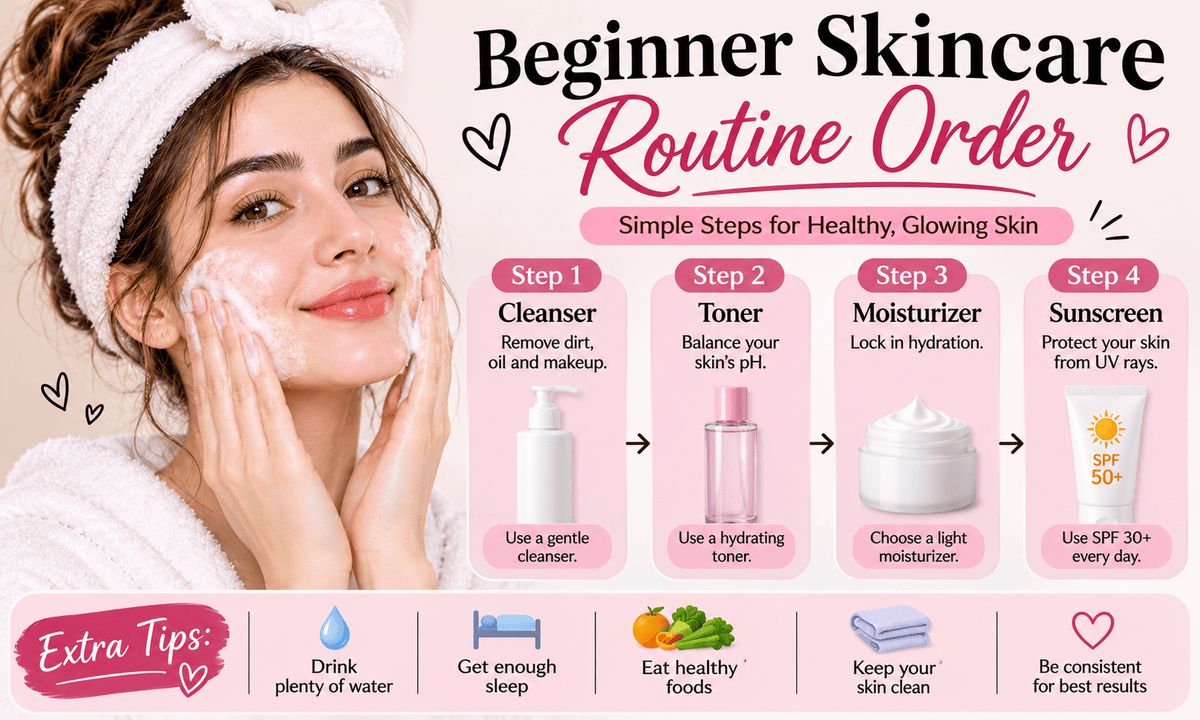
The beginner skincare routine order is: cleanser, then a treatment serum if you use one, then moisturiser, then sunscreen in the morning. At night it is cleanser, treatment if you use one, then moisturiser. Apply products from thinnest to thickest and give each one a minute or so to settle. Sunscreen is always the last skincare step in the morning, and makeup goes on after it. This is general information, not medical advice.
Why the order matters
If you put a thick cream on first, nothing that follows can reach the skin properly. If you put sunscreen under your moisturiser, you dilute it and move it out of position. The order is there so each product does its job: cleanser clears the surface, treatments go onto bare skin, moisturiser seals things in, and sunscreen forms a protective layer on top.
The good news for beginners is that the order is short. The Cleveland Clinic’s guidance for the minimum routine is a cleanser, followed by a moisturiser and then sunscreen in the morning. Dr Downie, in a Marie Claire guide, adds a serum to that list but says clearly that twelve steps are not required. Extras such as toning and exfoliating are optional.
The golden rule: thinnest to thickest
The general rule from dermatology guides is to apply products from the thinnest consistency to the thickest. Watery products go first, gels and serums next, then creams, and oils or balms last. A thick cream applied too early blocks a thin serum, so the serum never gets a chance to work.
There are two exceptions worth knowing:
- Prescription topical treatments. Medical News Today, summarising the American Academy of Dermatology’s advice, gives the general order as cleanser, topical medicinal creams, moisturiser, sunscreen and then makeup. If your dermatologist has given you specific instructions, follow those first.
- Sunscreen. It always goes last among skincare products, even though it is often thicker than your moisturiser. It needs to sit on top of the skin to protect it.
Morning routine order
In the morning your skin needs hydration and protection. Four steps is the maximum for a beginner.
- Cleanse, or rinse. A gentle cleanser removes the oil and residue that built up overnight. If your skin is dry or sensitive, a splash of lukewarm water may be enough. The American Academy of Dermatology suggests a gentle, non-abrasive cleanser without alcohol.
- Serum, if you use one. An antioxidant serum such as vitamin C is a common morning choice. Dr Mary Sommerlad, a London consultant dermatologist quoted by Hello!, recommends cleanser, an antioxidant, moisturiser and then SPF for a no-frills morning routine. If you do not use a serum, skip this step.
- Moisturise. Apply a moisturiser suited to your skin type. Lighter gels or lotions suit oily skin, and richer creams suit dry skin.
- Sunscreen. The American Academy of Dermatology recommends a broad-spectrum, water-resistant sunscreen with an SPF of at least 30, applied to the face, neck and ears, and reapplied every two hours if you are outdoors.
If you wear makeup, it goes on after sunscreen.
Evening routine order
In the evening the job is to remove the day and give your skin what it needs to repair overnight.
- Remove makeup and sunscreen. If you wear either, use a cleansing balm, oil or micellar water first, as Adore Beauty’s doctor-approved night routine starts with a makeup remover.
- Cleanse. Use your gentle cleanser. Massage for about twenty seconds and rinse with lukewarm water.
- Treatment, if you use one. This might be a retinoid, a gentle exfoliating acid or a prescription cream. These go on clean skin, before moisturiser.
- Moisturise. Use your usual moisturiser or a slightly richer one at night. Some people add a facial oil as a last layer.
Sunscreen is not needed at night.
Quick reference: the order at a glance
| Step | Morning | Evening |
| 1 | Cleanse or rinse | Remove makeup and sunscreen |
| 2 | Serum, if you use one | Cleanse |
| 3 | Moisturiser | Treatment, if you use one |
| 4 | Sunscreen (SPF 30 or higher) | Moisturiser |
| 5 | Makeup, if you wear it | Facial oil, optional |
How long to wait between steps
You do not need a stopwatch. A minute or so between layers is enough for most products to settle, and the skin should feel slightly tacky rather than wet before you add the next. Moisturiser works best on slightly damp skin, since it helps seal in water. Let sunscreen settle for a couple of minutes before makeup so it does not pill or move.
If products roll into little balls on your skin, it usually means you have applied too much, layered products that do not suit each other, or not waited long enough.
How to add new products safely
The most common beginner mistake is adding too much too fast. A new product should earn its place slowly.
- Start with the basics. Use a cleanser, moisturiser and sunscreen for at least two weeks before adding anything else.
- Add one product at a time. If you add three things and your skin reacts, you will not know which one caused it.
- Patch test. Apply a small amount to your inner arm or behind your ear for a couple of days before using it on your face.
- Go slowly with strong actives. Retinoids and exfoliating acids are more likely to irritate. Start with a couple of nights a week and build up as your skin allows, and avoid using several strong actives on the same night when you are starting.
- Stop if your skin reacts. If it stings, peels or turns red and blotchy, go back to a cleanser, moisturiser and sunscreen until your skin settles, then try again more slowly.
For prescription treatments, follow your dermatologist’s instructions on timing and order.
Keeping it simple
You do not need a serum, a toner or an eye cream to start. Well+Good’s guide to the American Academy of Dermatology’s advice lists four steps as the minimum for a routine: cleanser, treatment serum, moisturiser and sunscreen. And some people do fine with three. If your budget is tight, our affordable skincare routine for beginners sets out a four-step version that does not rely on expensive products.
Small adjustments by skin type
- Dry skin: use a creamy, hydrating cleanser, apply moisturiser to slightly damp skin and consider a richer cream at night.
- Oily skin: choose a gel cleanser and a light, oil-free moisturiser. Do not skip moisturiser, as dehydrated skin can look oilier.
- Combination skin: use a gentle cleanser all over and a lightweight moisturiser, with a richer layer on dry areas.
- Sensitive skin: keep it to the basics, choose fragrance-free products and patch test everything.
Common order mistakes
- Moisturiser before serum. It blocks the serum from reaching the skin.
- Sunscreen before moisturiser. It dilutes the sunscreen and breaks the protective layer.
- Skipping sunscreen. It is the most important step in the morning.
- Applying too many products at once. More layers do not mean more benefit.
- Over-exfoliating. Daily scrubs and acids can damage the skin barrier. Start with once or twice a week.
- Changing everything at once. Give a routine a few weeks before judging it.
When to see a professional
If you have persistent acne, itching, redness or rough patches that over-the-counter products do not help, see a dermatologist or pharmacist. A routine is a good foundation, but it is not a treatment for skin conditions.
Beginner skincare routine order FAQs
What order should I apply skincare products?
Cleanser, treatment serum if you use one, moisturiser and then sunscreen in the morning. At night, cleanser, treatment if you use one and moisturiser. Apply thinnest products first and thickest last.
Do I apply serum before or after moisturiser?
Before. Serums are thinner and need to reach the skin, so they go on after cleansing and before your moisturiser.
Should sunscreen go before or after moisturiser?
After. Sunscreen is the last skincare step in the morning, and makeup goes over it.
How long should I wait between skincare steps?
About a minute is enough for most products. Wait a couple of minutes after sunscreen before applying makeup.