You’ve seen it on screen. A young woman in a pale, floaty gown crosses a ballroom, the skirt skimming the floor, the waistline sitting just beneath her bust. A man in a dark tailcoat and a snowy cravat bows. It looks effortless, and it’s far more specific than most costume dramas let on.
Regency era fashion lasted barely a decade in the strict sense, yet it shaped how we picture the early 1800s. It also left a mark on modern wardrobes, from the empire waist dress to the sharp, restrained tailoring of a good suit.
This guide covers what people wore, why the style looked the way it did, what television gets wrong, and how to wear the look now without looking like you’re heading to a costume party.
What Was the Regency Era, Exactly?
Strictly speaking, the Regency ran from 1811 to 1820. King George III was judged unfit to rule, and his son, the future George IV, governed as Prince Regent. When George III died in 1820, the Regency ended and his son became king.
Dress historians, though, use the word more loosely. The fashions we call “Regency” took shape in the 1790s and lasted into the early 1820s, so you’ll often see the term applied to roughly 1795 to 1820. The look had a clear identity: high waists for women, plainer and more tailored clothes for men.
That broader window matters for the details. A gown from 1800 and one from 1818 are noticeably different, even though both count as Regency style.
Why the Fashion Changed So Dramatically
The elaborate silks, huge skirts and powdered wigs of the 1700s fell out of favour quickly. Several things pushed the change along.
Interest in ancient Greece and Rome was one. Sculpture and classical architecture were admired, and clothing began to echo their clean, columnar lines. Politics played a part too. After the French Revolution, flamboyant aristocratic display looked risky and out of step, and simpler dress felt more modern.
Trade and industry helped as well. Cotton, including fine muslin, became widely available, and fabrics that had once been luxuries reached more people. The result was a lighter, simpler silhouette, and one that looked completely different from what came before.
Women’s Regency Fashion: The Dress That Defined the Era
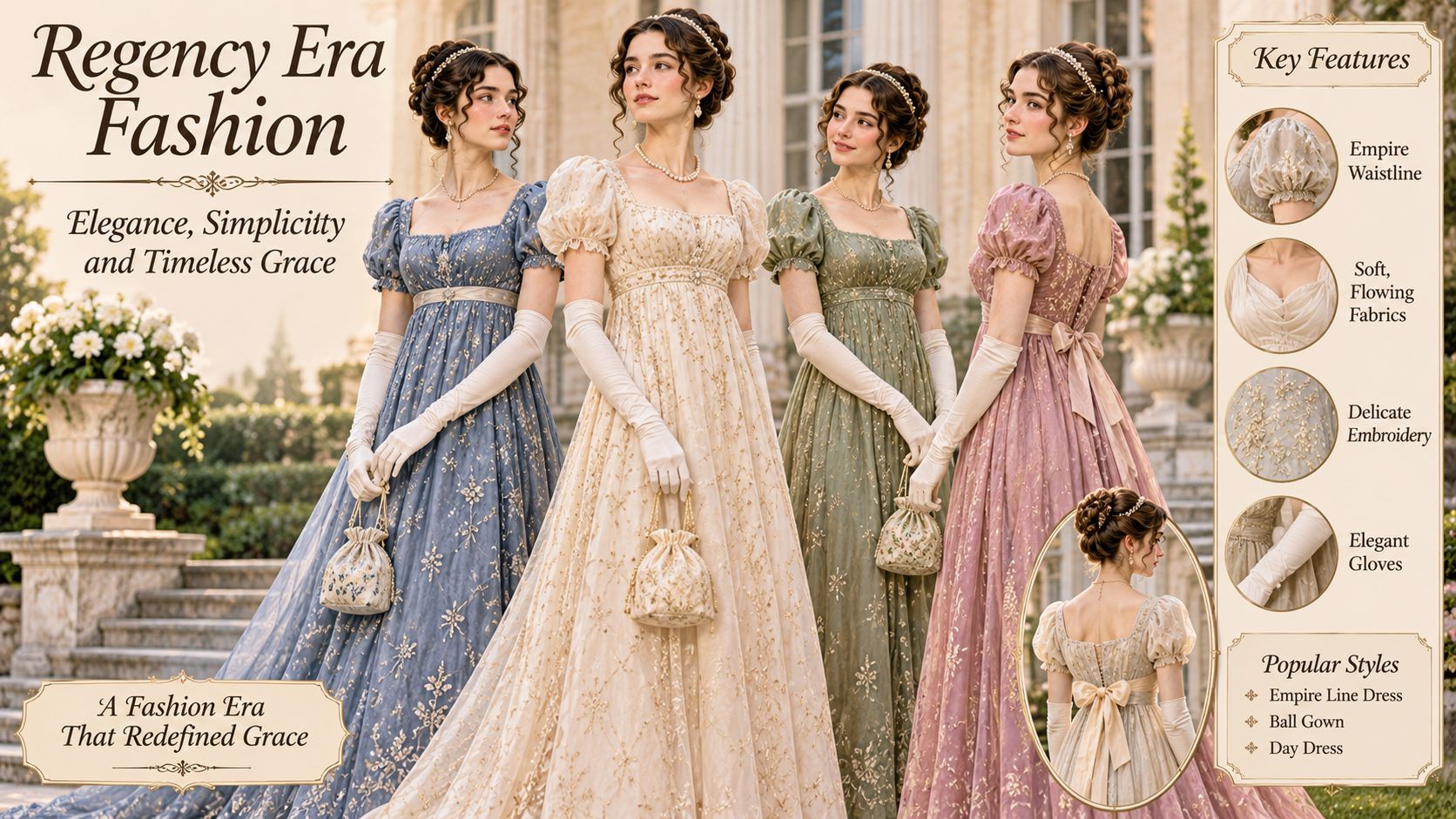
If one garment sums up regency era fashion, it’s the high-waisted gown. Here’s what made it distinctive.
The Empire Waist and Column Skirt
The waistline sat directly under the bust, and the skirt fell in a long, fairly slim line to the ankle or floor. That raised waist is the origin of the modern empire waist dress, which has never entirely gone out of style.
Necklines for day were often modest, sometimes filled in with a chemisette, a small undershirt-like piece. Evening gowns were lower cut, with short, puffed sleeves. As the years passed, the look shifted slightly: toward the end of the period, hems rose a little and gained decorative trim, and the waist began to creep downward.
Fabrics and Colours
Muslin, a light cotton, is the fabric most associated with the period, and white was hugely fashionable. But the idea that everyone wore only white is a common misconception. Pastels, soft prints and stronger colours were all worn, particularly in silk, and evening dress could be rich and glittering.
Wool and heavier cloth appeared in outerwear, naturally. English winters haven’t changed.
Undergarments
Women still wore stays, a lighter, shorter support than the heavily structured corsets people tend to imagine. Under that came a chemise, a simple linen or cotton shift. Underwear as we know it wasn’t standard for women in the period; drawers existed but only became common later.
Outerwear That Kept Everyone Warm
Light dresses needed cover. Women layered a spencer, a cropped fitted jacket, over a gown, or wore a pelisse, a longer coat-like garment that followed the line of the dress. Shawls, particularly soft cashmere ones, were prized and often handed down.
Hair, Hats and Hands
Hair was dressed in a softer, classically inspired style, often gathered up with loose curls framing the face. Bonnets were everyday wear outdoors, and evening turbans were popular. Gloves were essential, and fans were both practical and part of social life.
Slim gowns left little room for pockets, so women carried a small bag called a reticule. If you’ve ever wondered where the modern clutch came from, there’s a fair argument for this little drawstring pouch.
Men’s Regency Fashion: The Dandy and the Quiet Revolution
Regency men’s clothing makes a statement by doing less. It’s built on cut, fit and fabric rather than decoration.
Beau Brummell and the Cult of Restraint
No name is more tied to the look than Beau Brummell, a friend of the Prince Regent. He’s credited with popularising a refined, understated style: dark, well-fitted coats, spotless linen and meticulous grooming. Instead of lace and embroidery, a man showed taste through how precisely his clothes were cut and how clean they looked.
That is the root of modern tailoring. The idea that a dark, well-fitted suit signals good taste largely comes from this period.
The Core Pieces
A fashionable man’s outfit followed a clear formula:
- Tailcoat: fitted through the body, often in dark blue, black or other muted tones, and cut to emphasise the shoulders and waist.
- Waistcoat: close-fitting and the main place for pattern or colour.
- Shirt and cravat: a white linen shirt, with a cravat that was starched and tied in carefully chosen knots.
- Breeches or pantaloons: breeches ended at the knee, but longer trousers-style pantaloons gained ground as the period went on.
- Boots: polished leather boots, often worn with breeches, and a top hat to finish.
Cleanliness mattered enormously. Crisp linen was a visible sign of status because it needed constant washing and pressing.
Why It Still Matters
The Regency approach to menswear set a pattern that lasted. Dark colours, fit over ornament, and quiet confidence are still the foundation of formal dress today.
What Costume Dramas Get Right and Wrong
Shows like Bridgerton have sparked a fresh wave of interest, and that’s a good thing. But the series is a stylised fantasy, not a documentary.
The silhouettes, the empire lines, the tailcoats and the cravats are recognisable. What changes is the colour palette, the fabrics and the finish. Many costumes use bold, saturated shades, modern materials, and details borrowed from later periods or from contemporary fashion. They also tend to be far more glittery than real day dress would have been.
Think of it as a style inspired by the period rather than a record of it. That’s useful for anyone borrowing the look, because you get the freedom to adapt it.
How to Wear Regency Style Today
You don’t need a full costume. The trick is to take one or two ideas and keep everything else modern. Here’s a simple way to approach it.
- Start with the waistline. An empire waist dress or top is the easiest way in. Look for one that sits just under the bust and falls in a soft line.
- Pick the right fabric. Cotton, linen or lightweight voile give the right drape. Stiff, shiny fabrics fight the look.
- Choose soft colours. Ivory, cream, pale blue, sage and blush all feel true to the spirit of the era.
- Add one accessory, not six. A shawl, a pair of gloves, a ribbon in your hair or a small drawstring bag is plenty.
- Keep the rest simple. Flat shoes or ankle boots and minimal jewellery stop the outfit becoming costume.
For men, the approach is even easier. A fitted dark jacket, a crisp white shirt, a neat neckcloth or scarf and polished boots capture the mood without any fuss.
Common Mistakes to Avoid
- Going too literal. A full period outfit from head to toe tends to read as fancy dress. Mix one period piece with everyday clothes.
- Choosing cheap, shiny satin. Costume satin looks nothing like period fabrics. Matte natural textures look more convincing.
- Ignoring fit. The whole style relies on clean lines. Ill-fitting versions look sloppy, not romantic.
- Piling on trims. Regency style is about elegance. Too many ruffles and bows turn it into a different century.
Regency Jewellery and Accessories
Jewellery of the period was often delicate: pearls, cameos, small stones and fine chains. Cameos in particular fit the classical mood of the era, and pearls suited the pale, soft dresses.
If the romance of the period has you thinking about rings, the soft, elongated shapes in guides to oval engagement rings have a similarly graceful feel, even though they come from a very different time. Pair a ring like that with an empire-line dress and the effect is quietly elegant.
Other accessories worth knowing:
- Parasols and fans: useful and decorative, and still lovely today.
- Gloves: long or short, depending on the occasion.
- Hats and bonnets: straw bonnets with ribbon ties are the classic.
- Shoes: women wore flat, light slippers, often tied with ribbons, which is one reason ballet flats feel so natural with this style.
A Quick Comparison: Regency vs Victorian Fashion
People often mix the two, so here’s a simple way to tell them apart.
| Feature | Regency (c. 1795–1820) | Victorian (1837 onwards) |
| Waistline | High, under the bust | Natural or lowered, tightly fitted |
| Skirt shape | Slim, column-like | Wide, bell or later bustle |
| Overall mood | Light, classical, simple | Structured, layered, elaborate |
| Men’s style | Fitted tailcoat, breeches, cravat | Darker, heavier, frock coats and trousers |
The Regency era sits between the ornate 18th century and the heavier fashions that arrived later. That brief window of lightness is exactly why it feels so distinctive.
Frequently Asked Questions About Regency Era Fashion
What was Regency era fashion known for?
It was known for high-waisted gowns, light fabrics like muslin and a classical, slim silhouette for women. Men’s style centred on fitted tailcoats, starched cravats and understated elegance.
What years does Regency fashion cover?
The Regency itself ran from 1811 to 1820. In fashion history, the look is usually dated more widely, from about the 1790s to the early 1820s.
What did women wear under Regency dresses?
They wore a chemise and stays, which were lighter than the later heavy corsets. Drawers existed but weren’t standard at the time.
Who was Beau Brummell?
Beau Brummell was a close friend of the Prince Regent and a major trendsetter. He’s credited with popularising clean, understated tailoring and spotless linen, which shaped modern menswear.
Is Bridgerton historically accurate?
Not strictly. It uses Regency silhouettes as a base but adds modern colours, fabrics and styling for a fantasy effect. It’s best seen as inspired by the era rather than a record of it.
The Look That Keeps Coming Back
The thread running through regency era fashion is restraint. Women’s dresses followed the body with soft lines instead of rigid structure, and men let a perfect fit and clean linen do the talking. That’s why the style never fully disappears. Every few years it returns on the runway, in bridal wear, or on screen.
The easiest way to try it is small. Pick one piece, such as an empire waist dress, a crisp shirt and a dark tailored jacket, or a soft shawl, and build around it. Keep the rest of your outfit modern, and you’ll capture the romance of the period without the costume.