Quick answer
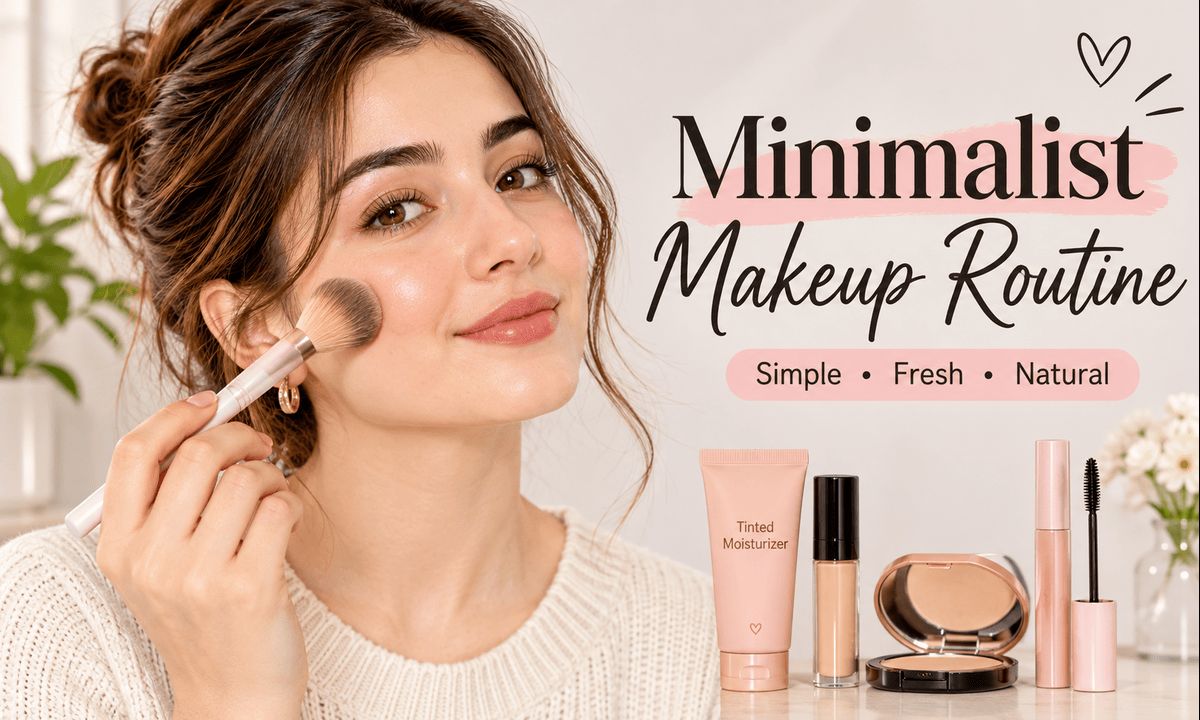
A minimalist makeup routine uses four or five multitasking products: a skin tint or light concealer, a cream blush that also works on the lips, a brow product, mascara and a tinted lip balm. Apply them in that order with your fingers or one brush and it takes about five minutes. The aim is to even out your skin and add a little colour, not to cover your face. Choose shades that match your skin and keep a short list you will actually use.
What minimalist makeup actually means
Minimalist makeup is not going without. It is choosing the few products that make the biggest difference and dropping the rest. Think of it as the opposite of a twelve-step routine: skin that looks like skin, a bit of colour on the cheeks, defined brows and lashes, and a soft lip.
The idea has caught on for practical reasons. A recent industry presentation cited by The Guardian put the average number of makeup products used per day at four per woman, which means a routine of four or five is a lot closer to normal than the ten-step tutorials suggest. Fewer products also means less to carry, less to replace and fewer things that can irritate your skin.
You will find different versions of the idea. Woman & Home’s writer cut her bag to six products covering complexion, brows, lips and lashes. Sigma Beauty suggests a skin tint, blush, eyeshadow, mascara and lips. Another blogger caps a minimalist collection at nine items. They all agree on the principle: every product has to earn its place.
The five products to keep
1. A skin tint or lightweight concealer
This is the base. If your skin is fairly even, a sheer skin tint or tinted moisturiser is enough, and a dab of concealer under the eyes and on any blemishes does the rest. If you are prone to redness or shadows, a lightweight foundation applied only where you need it works just as well.
Choose the finish by skin type. Dry skin does best with a hydrating tint that looks fresh rather than flat. Oily skin suits a lightweight, semi-matte formula. Whichever you pick, match the shade to your jawline in daylight, and apply with fingers or a damp sponge for a skin-like finish.
2. A cream blush that doubles as lip colour
If you could only keep one colour product, this would be it. A cream blush melts into the skin, blends with your fingertips and looks natural. Dab a little on your lips as well and your face is balanced with one product.
Pick the shade by undertone. Warm skin suits peach, coral and soft terracotta. Cool skin suits rose, pink and berry. Deeper complexions look good in rich berry, plum and warm brick. If you are unsure, a soft rose or warm peach works on most people.
3. A brow gel or pencil
Brows frame the face, and a little definition makes the rest of your makeup look more finished. If your brows are full, a clear or tinted brow gel brushed upwards is enough. If they are sparse, use a thin pencil to fill gaps with light, feathery strokes.
4. Mascara
Mascara opens the eyes faster than anything else. Brown or brown-black is softer than black on lighter colouring. Curling your lashes first makes the effect stronger. Replace mascara every three months or so, since bacteria build up in the tube.
5. A tinted lip balm
A tinted balm gives you comfort and colour in one step. Pick a shade a little deeper than your natural lip colour, so it looks like your lips on a good day. If your cream blush works on the lips, you can leave this out and keep a plain balm instead.
The five-minute order of application
- Skin first (1 minute). Cleanse, moisturise and apply sunscreen. Let it settle before makeup goes on.
- Tint and concealer (1 minute). Dot the tint on the centre of your face and blend outwards. Add concealer only where needed.
- Blush (1 minute). Tap cream blush onto the apples of your cheeks and blend upwards. Press a little onto your lips.
- Brows (1 minute). Brush brows up and fill any gaps lightly.
- Lashes and lips (1 minute). Curl, add mascara, then finish with a tinted balm if you did not use your blush.
A minimalist routine only looks like skin if the skin underneath is comfortable and well looked after. If your basics are not sorted, start with our guide to an affordable skincare routine for beginners, then add makeup on top.
Optional extras, ranked
Once the five are working, add one extra at a time and keep it only if you reach for it.
- A neutral eyeshadow or eyeliner for evenings or when you want more definition.
- A highlighter, in a cream or liquid formula, for a little glow on the cheekbones.
- A light setting powder, useful if you have oily skin or a warm climate.
- A bronzer, if you like a warmer base in summer.
A good test is to ask whether the extra is something you have used at least three times in the last month. If not, it was a want rather than a need.
Minimalist makeup routine by skin type
- Dry skin: hydrating tint, cream blush and a balm, and skip powder altogether.
- Oily skin: a lightweight tint, a cream blush set with a tiny dusting of powder on the T-zone, and a long-wear mascara.
- Combination skin: tint on the cheeks and forehead only, concealer where needed and a cream blush.
- Mature skin: cream formulas and sheer coverage, since powders can settle into fine lines. A brow gel and mascara do a lot to lift the face.
- Deeper skin tones: pay extra attention to the shade of your tint and concealer, and pick blushes with enough pigment to show, such as rich berry, plum and warm brick.
- Sensitive skin: fewer products also means fewer ingredients. Choose fragrance-free formulas and patch test new products.
What to skip, and how to declutter
Minimalism is as much about what you take out as what you put in. These are the products that most routines can live without:
- Contour kits and several different foundations.
- A lipstick for every outfit.
- Multiple eyeshadow palettes that overlap.
- Setting spray and primer, unless you have a specific need for them.
- Anything you bought for a single look and never used again.
To downsize your collection, tip everything out and sort it into three piles: used in the last month, not used, and expired or smelling off. Woman & Home’s feature on cutting a makeup bag to six products makes the same point about checking whether old formulas are still safe to use. Keep the first pile, give away or recycle the second, and bin the third. Marie Claire’s writer who limited herself to ten beauty products reports that the clear-out also made getting ready much faster.
Common mistakes
- Using the wrong tint shade. A base that is too light or too dark makes a minimal routine look obvious. Match it to your jawline in daylight.
- Buying single-use products. The point is to pick items that do two jobs, such as a cream blush for cheeks and lips.
- Overdoing the concealer. Dot it where you need it. Covering your whole face defeats the idea.
- Forgetting sunscreen. It is not makeup, but it is the most important step before it.
- Keeping products too long. Mascara is best replaced every three months or so, and any product that smells or looks different should go.
Minimalist makeup routine FAQs
What is a minimalist makeup routine?
A short routine built from a handful of multitasking products, such as a skin tint, cream blush, brow product, mascara and tinted balm. It evens skin tone and adds a little colour without heavy layering.
How many products do you need?
Four or five covers most people. The Guardian reports that the average person uses around four makeup products a day, and different guides settle on anywhere between five and nine for a full minimalist collection.
What is the simplest daily makeup routine?
Sunscreen, a little concealer, cream blush, brow gel and mascara. That is roughly five minutes and five products, or fewer.
Do I need foundation?
No. A skin tint, a tinted moisturiser or concealer alone is enough for most days. Use foundation only if you want more coverage.
Can I do a minimalist routine with drugstore products?
Yes. The idea is to pick good multi-use products, not expensive ones. Check that the tint shade matches and that the cream blush blends easily.
Is minimalist makeup good for sensitive skin?
It often helps, because fewer products means fewer ingredients. Choose fragrance-free formulas where you can, and patch test new products on your jaw before using them on your face.