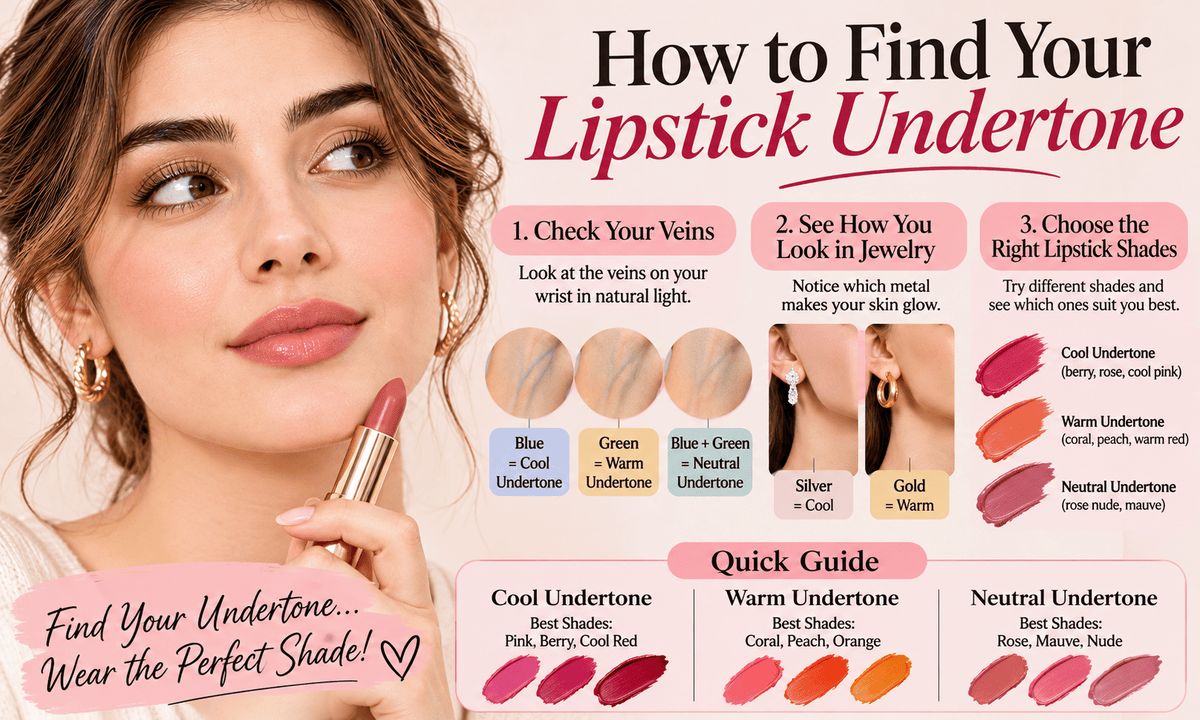
To find your lipstick undertone, work out whether your skin is warm, cool or neutral, then choose lipsticks with the same temperature. Check your wrist veins, try gold and silver jewellery against your skin, hold white paper next to your bare face, notice how you react to the sun and swatch a few lipsticks in daylight. Cool undertones suit blue-based reds, berries and mauves. Warm undertones suit orange-reds, coral and terracotta. Neutral undertones can wear both.
What “lipstick undertone” means
The phrase gets used in two ways, and both matter. One is your skin undertone, which decides which lipsticks flatter you. The other is the lipstick’s undertone, the hidden base colour beneath the obvious shade family.
A red can lean blue (cool), lean orange (warm) or sit in the middle (neutral). The same goes for pinks and nudes. The shortcut that works for most people is to match the lipstick’s temperature to the temperature of your skin, then adjust the depth and finish.
Undertone is not the same as skin tone
Skin tone, or depth, is how light or deep your skin looks. Undertone is the cool, warm or neutral tint beneath the surface, and it stays the same however much you tan. Glam makes a useful point here: fair skin can have a neutral or warm undertone, and deep skin can be cool-toned. You cannot guess undertone from depth.
That is why two people with similar complexions may need very different lipsticks. Depth tells you how bright or deep a shade should be. Undertone tells you whether it should lean warm or cool.
Five simple tests to find your undertone
No single test is perfect, so try at least three and go with the answer that comes up most often. Do them in natural daylight, with minimal makeup, because foundation can hide undertone clues.
1. The wrist vein test
Look at the veins on the inside of your wrist. If they look blue or purple, your undertone is probably cool. If they look green, it is probably warm. If you see a mix, or cannot tell, you may be neutral. This is one of the most common tests from brands such as Maybelline, L’Oréal Paris and Max Factor. It is a guide, not a verdict, because lighting and skin thickness can change how veins appear.
2. The jewellery test
Hold a piece of silver and a piece of gold against your bare skin. Silver tends to flatter cool undertones, gold tends to flatter warm ones, and if both look good you are probably neutral. It relies more on instinct than measurement, so ask a friend to help if you are unsure.
3. The white paper or fabric test
Hold a sheet of pure white paper beside your bare face, then a sheet of cream or off-white. If your skin looks fresher against the white, you lean cool. If it looks healthier against the cream, you lean warm. Nykaa describes a version of this using two pieces of fabric. Check in daylight and look at your whole face, not just one area.
4. The sun test
Think about how your skin responds to sun. Laura Mercier suggests that people who burn easily and rarely tan are likely to be cool, while those who tan easily and turn golden are more likely to be warm. This is the least reliable of the five, because sun reaction depends on many things, but it helps break a tie.
5. The lipstick swatch test
This is the one that settles it. Wipe your lips and try a blue-based pink or red on one side and an orange-based red or coral on the other, or swatch both on your jaw. Axiology Beauty notes that the right shade makes your complexion glow and your teeth look whiter. The shade that brightens your face and makes your skin look even is your undertone family.
Putting the results together
Tally what you got. Mostly cool answers mean cool. Mostly warm answers mean warm. Mixed answers, or both working well in the jewellery test, point to neutral. If you are still unsure, go with the swatch test, because that is what you will actually wear.
How to tell if a lipstick is warm or cool
Once you know your own undertone, you need to read the lipstick. The easiest way is to look at where the colour sits on the colour wheel. Red Apple Lipstick explains that a warm red leans towards orange, yellow or a pinkish red, while a cool red has a purple, blue or even green base. The same logic applies to pinks, which can be warm (red, orange or yellow base) or cool (purple or blue base).
Three habits make this easier:
- Swatch on white paper or the back of your hand. A colour stands out far more against white than it does in a tube.
- Look at the bullet and the swatch, not the packaging. Cases are often a poor guide to the colour inside.
- Compare two reds side by side. The difference between a blue-based and an orange-based red is far easier to see together than apart.
Neutral lipsticks have balanced undertones and do not lean strongly either way. Maybelline India gives coffee colours and taupes as examples.
Best lipstick shades by undertone
Warm undertones. Maybelline India’s list for warm skin includes orangey reds, brick reds, terracotta, peach, coral, warm browns and caramel. These shades pick up the golden warmth in the skin.
Cool undertones. Cool skin suits cool lipsticks such as bluish reds, pinky reds, rose pinks, berry, mauve and plum. Laura Mercier points to berry, mauve and true reds for cool undertones, and Clinique, as quoted by Glam, describes bluish-red or pinkish shades as the cool reds.
Neutral undertones. You can wear both families. Balanced reds, rosy nudes, soft taupes and coffee-brown shades work particularly well, and you can mix warm and cool within one look.
Olive skin. Olive undertones can be hard to pin down because of a slightly green cast. If warm corals look too orange and cool pinks look ashy, try brick red, terracotta, brown-berry or a warm red.
Match depth and finish, not just undertone
Undertone is step one. A glamgeek guide suggests matching the undertone direction first, then adjusting the depth, then choosing the finish. Here is what that means in practice:
- Depth: lighter skin usually suits lighter, softer versions of a shade, while deeper skin carries richer, darker versions. For an everyday nude, pick one a touch deeper than your natural lip colour.
- Finish: creamy satin for comfortable daily wear, matte for staying power, gloss for softness.
- Occasion: keep a daily shade, a polished shade for meetings and a statement shade for evenings, all within your undertone family.
Once you know your shades, browse more of our lip colour guides for formulas and looks in your family.
When the undertone rules do not work
Undertone is a guide, not a law. You might be neutral and happy in both camps. You might love a shade that the rules say is wrong for you. Or you might find that a lipstick which used to suit you has stopped working. Red Apple Lipstick notes that the cool or warm shades you wore years ago can look dull as you get older.
Here are some fixes:
- A blue-red looks harsh. Try a stain or tap the lipstick on with your finger for a softer, diffused edge. Sterling Style Academy suggests choosing a red in your undertone: a blue-red for cool, a tomato or brick red for warm and a balanced red for neutral.
- A shade looks tired. The depth is probably wrong. Try one a little lighter or a little deeper.
- You love both warm and cool. Wear both. Neutral skin can handle either, and a lip liner in a middle shade can bridge two colours.
- Foundation is hiding your undertone. Test with bare skin or a minimal base.
Common mistakes when choosing lipstick
- Judging in the shop lighting. Warm bulbs make everything look more flattering than daylight does.
- Choosing by depth alone. A pale nude can still be the wrong undertone.
- Trusting one test. Use at least three and compare.
- Ignoring your natural lip colour. The lipstick sits on top of it, so it changes the result.
- Never trying the opposite. Occasionally testing a shade outside your family can show you something unexpected.
How to find lipstick undertone FAQs
How do I know if my lipstick is warm or cool?
Look at where the colour sits on the colour wheel. Warm lipsticks lean orange, yellow or coral, and cool ones lean blue, purple or pink. Swatch them side by side on white paper to compare.
How do I find the right lipstick for my skin tone?
Find your skin undertone using at least three tests, such as wrist veins, jewellery and the white paper test. Choose lipsticks in the same temperature, then adjust depth and finish.
Does lipstick undertone really matter?
It matters, but it is a guide. The right undertone makes your skin look brighter and your teeth look whiter. A shade in the wrong undertone can look dull, ashy or harsh, although depth and finish also play a part.
What lipstick suits neutral undertones?
Almost everything. Balanced reds, rosy nudes, taupes and coffee-brown shades are particularly easy, and you can wear both warm and cool shades.
What red lipstick suits me?
Cool undertones suit blue-based reds. Warm undertones suit tomato or brick reds. Neutral undertones suit a balanced red that does not lean strongly either way.