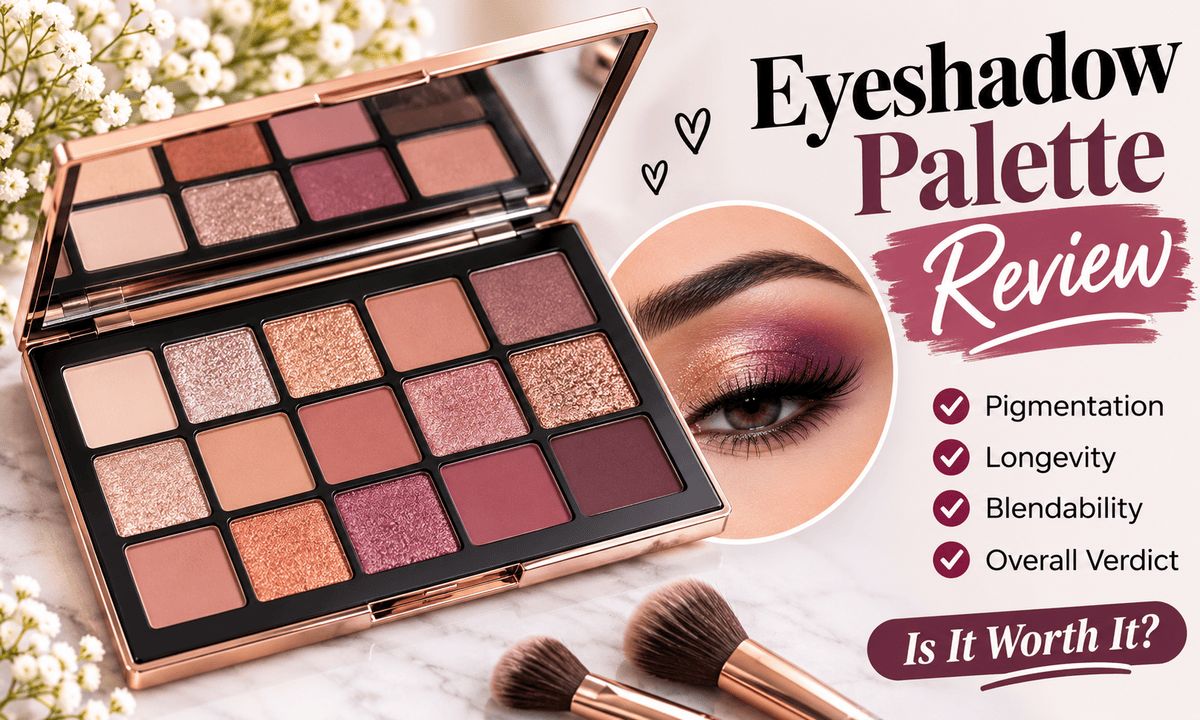
A good eyeshadow palette passes five checks: pigmentation, blendability, longevity, shade usefulness and a sensible mix of finishes. Judge it by how many shades you would actually wear, not how many pans it holds, and match the undertones to your skin and eye colour. For most people, a neutral palette with several mattes, a couple of shimmers and one deeper shade is the best first buy. Expensive does not automatically mean better, so look at what independent reviewers say about the formula.
A note on how this review works
Most palette reviews are a list of products with a star rating. That is useful once you already know what a good palette looks like, and much less useful if you do not. So this guide does two things. It sets out the checks that separate a good palette from a pretty one, and it summarises what independent editors have said about some well-known palettes.
The palettes named below come from published reviews and retailer guides, not from our own testing, so treat them as starting points. Formulas change between releases, and a palette that was praised two years ago may have been reformulated.
The five checks that decide whether a palette is worth buying
1. Pigmentation
Pigment is how much colour you get from a swipe. A well-pigmented shade shows up clearly with one pass of a brush, while a weak one needs several layers and still looks patchy. Check the whole palette, not just the showpiece shades. Pale mattes are the usual weak point, and on deeper skin tones they can disappear. Who What Wear’s guide to palettes for dark skin leans heavily on pigment for exactly this reason.
2. Blendability
A blendable shadow melts into the lid without leaving harsh edges or patches. Try blending the edge of one shade into the next. If it clings in streaks or lifts the shade underneath, it will be frustrating to use. Very dry, chalky mattes and over-sparkly shimmers are the common offenders.
3. Longevity
For a fair test, wear it with a primer or a thin layer of concealer for eight hours. Look for creasing in the lid fold, fading in the centre and any glitter fallout on your cheeks. If your lids are oily, a palette that looks good for four hours and slides by lunchtime is not a good fit.
4. Shade usefulness
This is the check that saves the most money. A 30-shade palette that has six wearable shades is worse value than a 9-shade palette in which you would wear seven. Count the shades you can honestly picture on your eyes. One source on palette reviews also points out that large palettes often include shades most people will not use, and pressed powders can develop a hard top layer if they are not cleaned.
5. Finish mix
A versatile palette combines mattes for the base and crease, satins for soft depth, and shimmers or metallics for the lid. Glitter looks fun but is a high-maintenance addition. Mature lids and hooded eyes tend to wear satins and soft mattes more comfortably than loose sparkle.
A simple scorecard you can use
Give a palette a score from one to five on each of the five checks, then do one more calculation: divide the price by the number of shades you would actually wear. That figure, the price per wearable shade, is usually a better guide than the sticker price.
For example, a palette with twelve shades, seven of which you would wear, that costs the same as a palette with eighteen shades, of which only five are useful, is the better buy, even though it looks smaller.
A palette that scores four or five on pigmentation, blendability and shade usefulness is almost always a good buy. Longevity matters most if your lids are oily or you wear makeup all day. Finish mix matters most if you only own one palette.
Which type of palette suits you?
Beginners. Stick to a small neutral palette, around nine to twelve shades, with a mix of mattes and one or two shimmers. A makeup artist quoted by Yahoo Lifestyle advises beginners to stay with neutral tones that complement their natural undertones, which keeps the learning curve gentle.
Everyday wear. Look for a palette with a light matte for the base, a mid-tone for the crease, a deeper shade for definition and a satin or shimmer for the lid. That four-part structure is all you need for most days.
Deeper skin tones. Pigment matters most. Who What Wear notes that colourful eyeshadow is back for 2026 and picks palettes known for rich payoff, so look for strong mattes and metallics that show up in a single swipe.
Tight budgets. A small, well-reviewed palette is better than a large, cheap one full of weak shades. Check that the pale mattes work and that the shimmers do not shed everywhere.
Minimal makeup bags. A single neutral palette that covers day and evening makes more sense than several overlapping ones.
How to test a palette before and after you buy
- Check it in daylight. Shop lighting hides undertones. If you can, look at the shades next to a window.
- Use a clean applicator. In a shop, ask for a disposable applicator rather than using the tester with your finger.
- Swipe once. One pass on the back of your hand shows the real pigment. Several passes show how well it builds.
- Prime your lids. Test on a primed lid, not bare skin, because that is how you will wear it.
- Wear it for a full day. Note creasing, fading and fallout at four hours and again at eight.
- Know the return policy. Many retailers will not accept returns on opened makeup, so ask before you buy.
Matching a palette to your eye colour
Your skin tone sets the palette’s overall warmth, and your eye colour helps you pick the accent shades. Maybelline UK suggests nude shades or blues for blue eyes, purples and pinks for green eyes, teal, soft pink or copper for grey eyes, emerald or golden tones for brown eyes, and gold, bronze or olive for hazel eyes. A Woolworths beauty guide adds that brown eyes suit warm bronze, peach and navy. None of these are rules. They are a quick way to see which shades in a palette to reach for first.
Common palette mistakes
- Buying by shade count. More pans does not mean more looks.
- Ignoring undertone. A palette that clashes with your skin or eyes will look wrong however good the formula.
- Skipping primer. Most creasing problems come from the lid, not the palette.
- Never cleaning brushes. Dirty brushes make shadows patchy and can irritate your eyes.
- Keeping palettes forever. Check the period-after-opening symbol on the packaging, and throw away any palette that smells off or causes irritation.
If you want to put a new palette to use, our eye makeup guides walk through looks from simple everyday washes to evening eyes.
Eyeshadow palette review FAQs
How do I choose an eyeshadow palette?
Start with your undertone, then check pigmentation, blendability, longevity, shade usefulness and finish mix. For a first palette, pick a neutral one with several mattes and a couple of shimmers.
What makes a good eyeshadow palette?
Strong colour payoff, easy blending, wear that lasts all day and a good number of shades you will genuinely use. A balanced mix of matte, satin and shimmer finishes makes it versatile.
How many shades do I need?
Nine to twelve is plenty for most people. What matters is how many you would wear, not how many the palette holds.
Matte or shimmer?
Both. Mattes shape the eye and make a reliable base, while shimmers add light. Superdrug’s guide recommends a mixture of shimmer and matte for dimension.
Are expensive palettes worth it?
Sometimes. Higher-priced palettes often have better pigment and blendability, but plenty of budget palettes get good reviews too. Judge on formula and shade usefulness, not on the price.
How do I test pigmentation?
Swipe each shade once with a clean finger or brush on the back of your hand, in daylight. Strong colour from one swipe means good pigment.